
Dubuque Epoxy Flooring installs polyaspartic floor coating in Dubuque, IA, backed by 20+ years of grinding and coating concrete, serving surrounding cities including Asbury, Platteville, The Galena Territory, Dyersville and Lancaster. Polyaspartic is the fast-curing, sunlight-stable coating that sits on top of most of our garage systems and many of our commercial floors.
Its selling points are real: a short cure, strong abrasion resistance and color that does not amber in a sunny garage door opening. Those advantages only show if the slab underneath is ground, repaired and dry, because a fast-curing coating fails just as fast on a damp or etched slab as a slow one.
We test every slab for moisture before we price the floor, and the proposal names the polyaspartic product, where it goes in the system, and the finished thickness. That makes it easy to see what you are buying and compare it with any other quote you get.
What Polyaspartic Floor Coating Is
The Chemistry in Plain Terms
Polyaspartic is a two-part aliphatic polyurea. Mixed together, the two parts react and cure into a hard, flexible film far faster than a standard epoxy. The aliphatic chemistry is what keeps it from yellowing under ultraviolet light, which is a known weakness of epoxy near doors and windows.
Because it cures so quickly, the working time after mixing is short. Our crews mix small batches, spread and back-roll them in a set pattern, and broadcast flake or quartz on schedule so the coating does not set up before the next step.
Polyaspartic Compared With Epoxy
Epoxy builds thickness in one coat and bonds very well to ground concrete, which is why we often still use a 100% solids epoxy as the base. Polyaspartic resists abrasion, chemicals and ultraviolet light better and cures in a fraction of the time, so it makes an excellent topcoat.
Using the two together gives a floor the strengths of each. The epoxy base wets into the ground profile and carries the flake, and the polyaspartic topcoat takes the tire traffic, the salt and the afternoon sun.
Full Polyaspartic Systems
Some floors are built entirely with polyaspartic, from the base coat through the clear topcoat. These systems can be finished faster and work well where downtime is the main concern. They demand careful slab preparation and an experienced crew, since there is little time to correct an uneven coat.
Whether a full polyaspartic build or a hybrid with an epoxy base suits your floor depends on the slab, the schedule and the budget. We explain the trade-off on site and write the chosen layers into the proposal, so the system you approve is the one that gets installed.
Where Polyaspartic Works Best
Garages Through Salt Season
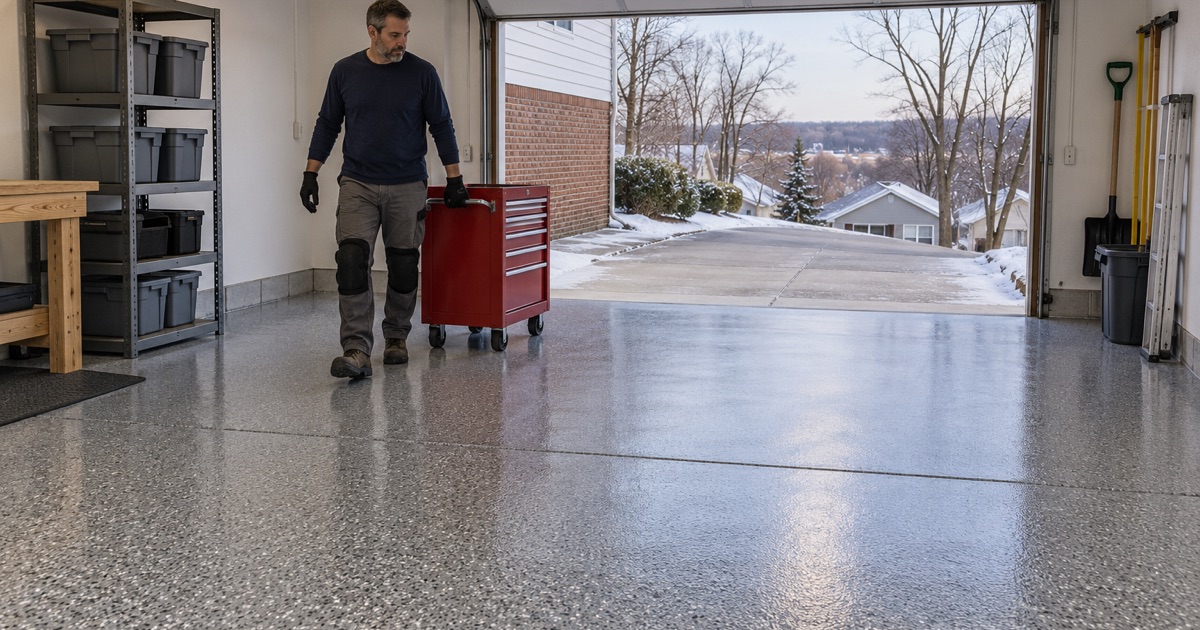
Garage floors face hot tires, dropped tools, and calcium chloride brine and rock salt that ride in from November through March. A polyaspartic topcoat resists the abrasion and the chemicals, and its smooth surface lets slush be squeegeed out the door. A full flake broadcast under it adds texture and hides tire marks.
Sun matters in a garage too. With the door open on summer afternoons, an epoxy topcoat can amber over time where the light hits, while a polyaspartic topcoat keeps the color true across the whole floor.
Showrooms and Sunlit Commercial Floors
Showrooms, lobbies and offices with large windows benefit from a coating that will not yellow. Polyaspartic topcoats over decorative flake, quartz or metallic epoxy keep the finish looking the way it did on install day. They also handle the cleaning chemicals commercial floors see daily.
Where customers walk in from wet parking lots, the topcoat can carry a fine grit so the entry is not slick under snowmelt. We set that texture by the broadcast and topcoat chosen, and show you a sample so the feel underfoot is agreed before the floor goes down.
Floors That Have to Reopen Quickly
Restaurants, shops and service businesses often cannot close for several days while a floor cures. A polyaspartic system lets us phase the work through a night or weekend and return areas to service sooner. We agree on the schedule in writing so everyone knows when each area is back in use.
The same holds for homeowners who need the garage back. A faster system means the cars are out for less time, though the drive-on time still follows the product and the slab temperature rather than a fixed promise.
How We Install a Polyaspartic System
Grinding and Moisture Testing First
Every polyaspartic floor starts with diamond grinding or shot blasting to the profile the product calls for, with the dust captured at the machine. Then the slab is moisture tested, starting with an ASTM D4263 plastic sheet test and moving to ASTM F1869 or ASTM F2170 testing when the result needs a closer look.
A newer garage gets the same test as an old one. IRC R506.2.3 lets garage slabs be poured without a vapor retarder, so the age of the house does not tell us how dry the concrete is.
Temperature, Humidity and Dew Point
Polyaspartic tolerates cooler temperatures than most epoxies, but it is sensitive to humidity during the cure. We check the slab temperature and the dew point spread before mixing, because moisture condensing on a cold slab can cause bubbles, haze or a poor bond.
In an unheated garage in the middle of a Dubuque winter, we will still tell you to wait. A product’s wide temperature range does not make a frozen slab ready for coating.
Building the Layers
After repairs, the base coat goes down, followed by a flake or quartz broadcast while it is wet. Once the excess is scraped and vacuumed off, the clear polyaspartic topcoat seals everything in. The sheen and any grit additive are chosen at this stage to set the look and the traction.
Edges, steps and the joint at the garage door get extra attention, since that is where coatings tend to chip first. We cut the coating in cleanly at the door and along walls, and we carry it over repaired joints so the finished floor reads as one continuous surface.
Limits Worth Knowing Before You Buy
Moisture and Warranty Exclusions
No coating, however quick it cures, holds back vapor or water pushing up through a slab. Coating warranties generally exclude failures from moisture vapor transmission and hydrostatic pressure, and we explain that exclusion before you sign.
Where the readings are high but there is no active water, a moisture-mitigation primer can go under the system. Where water is actually coming in, that problem has to be handled first.
Cracks and Slab Movement
Polyaspartic is somewhat flexible, but it will not bridge a crack that keeps moving. We map and repair cracks and spalls before coating and tell you when a section of slab needs replacement. A coating over a heaving slab will crack along with it.
Control joints are a separate question. Some owners want them filled and coated over for a seamless look, while others prefer them left open to show where the slab is meant to move. We explain what each choice means for that floor before the work begins.
VOC Rules Across Three States
Iowa and Wisconsin jobs fall under the federal 40 CFR 59 Subpart D rule that binds coating manufacturers. Illinois has its own limits in 35 Ill. Adm. Code Part 223, so we select products for Illinois jobs to meet them. Low-odor products elsewhere are offered for comfort in attached spaces.
Whatever the state, we ventilate during the install and give you a re-entry time for an attached garage or basement. Odor fades as the coating cures, and keeping the door to the house closed and the garage aired out during that window makes the process easier on the household.
- 20+ Years on Concrete
- Moisture Tested Before Pricing
- Diamond Ground, Never Acid Etched